Landfill leachate is a highly concentrated and complex wastewater generated from municipal solid waste facilities such as landfills, transfer stations, and compaction sites. It typically contains high levels of organic matter, ammonia nitrogen, heavy metals, and various refractory pollutants, earning its reputation as one of the most challenging types of wastewater to treat. In response to these extreme conditions, tubular ultrafiltration (UF) membranes have become a core technology in modern leachate treatment systems, thanks to their superior structural durability and resistance to fouling.
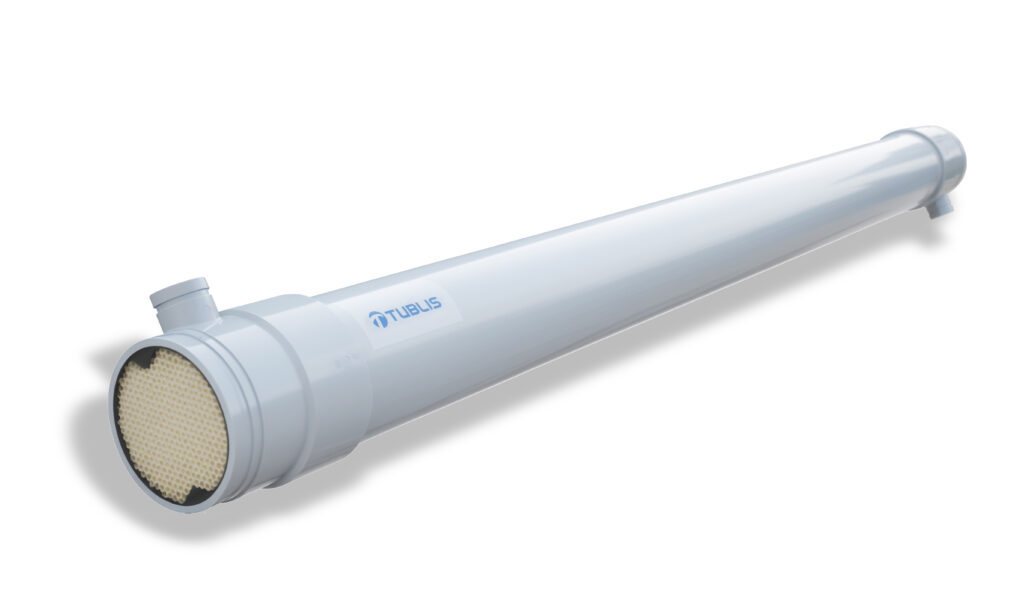
Constructed from high-strength PVDF, tubular UF membranes exhibit excellent resistance to fouling, oxidation, and chemical corrosion. Even in high-load environments, they maintain stable performance, delivering flux rates between 80–200 L/m²·h. With a precise pore size of 30 nm, they effectively remove suspended solids, colloids, and large organic molecules—ensuring high-quality permeate while providing critical protection to downstream reverse osmosis (RO) or nanofiltration (NF) systems. This not only improves overall treatment performance but also reduces membrane fouling and extends the service life of the entire system.
In real-world applications, tubular UF membranes are typically used as a primary filtration step within a broader treatment train that includes equalization tanks, flotation or coagulation units, and advanced processes such as RO or disc-tube reverse osmosis (DTRO). Compared to other membrane types like hollow fiber or flat sheet membranes, tubular membranes are better suited for wastewater with high suspended solids content and fluctuating water quality. Their open-channel design allows for easy and efficient cleaning through backflushing, air scouring, or chemical cleaning, leading to lower maintenance and operational costs.
Tublis tubular UF membranes offer an ideal solution for managing high-strength wastewater while helping clients meet stringent discharge standards, reduce operational costs, and move toward environmentally responsible and economically viable treatment strategies.
In real-world applications, tubular UF membranes are typically used as a primary filtration step within a broader treatment train that includes equalization tanks, flotation or coagulation units, and advanced processes such as RO or disc-tube reverse osmosis (DTRO). Compared to other membrane types like hollow fiber or flat sheet membranes, tubular membranes are better suited for wastewater with high suspended solids content and fluctuating water quality. Their open-channel design allows for easy and efficient cleaning through backflushing, air scouring, or chemical cleaning, leading to lower maintenance and operational costs.
1. It has strong anti-pollution ability and can adapt to poor water quality
The tubular UF membrane adopts a large-channel design and can withstand a suspended solids concentration of up to 40 g/ L. It is particularly suitable for the primary separation and concentration of leachate with high COD, SS and oil content.
2. Efficient retention to protect the back-end membrane system
As a pretreatment unit for reverse osmosis (RO) or nanofiltration (NF) systems, UF membranes can effectively remove large-molecule organic substances, colloids, suspended solids, etc., reduce the risk of RO membrane contamination, and extend its service life.
3. Stable operation and easy to clean
The tubular membrane structure is robust, adaptable to frequent backwashing, air-water scrubbing and chemical cleaning, with strong cleaning recovery, simple daily maintenance and a long operating cycle.
4. Modular design for flexible deployment
It can be rapidly expanded or combined according to the processing scale, adapting to different usage scenarios such as landfills, emergency treatment vehicles, and transfer stations, and is convenient for installation and integration.

Leachate pretreatment (regulating tank + air flotation + coagulation) → tubular UF system → RO advanced treatment → effluent discharge/reuse
In this process, the UF system, as a key filtration node, not only enhances the stability and security of the entire processing system but also significantly reduces the operating costs of the subsequent RO system.